(´ω`)ノ Nod Kaomoji
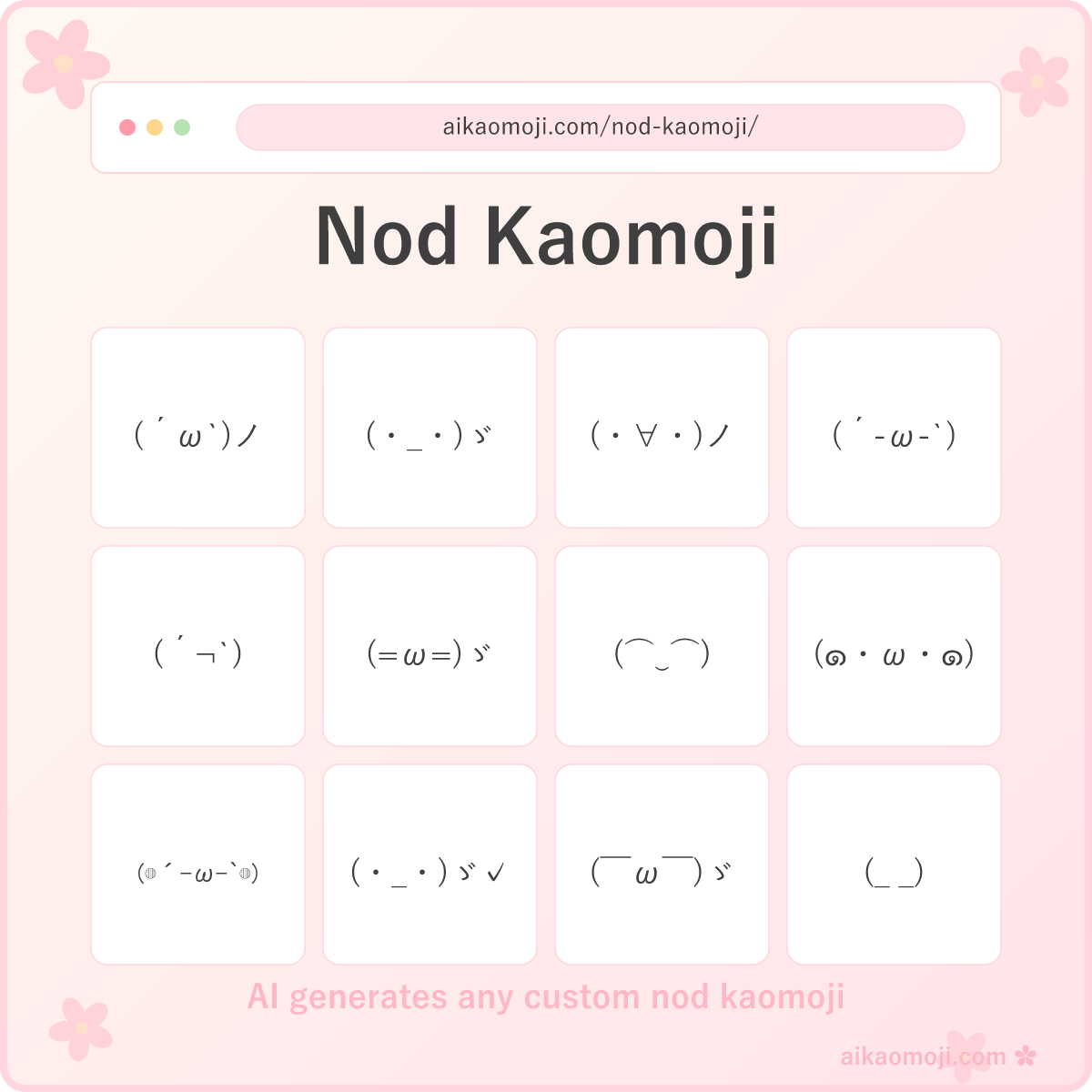
Nod kaomoji cover the acknowledging reaction moment — a Slack message you agree with, a Discord reply confirming you're on it, a Twitter quote-tweet nodding along to a good take. The canonical nod kaomoji shape is (´ω`)ノ — a soft-eye face with a raised katakana ノ hand reading as "got it, agreeing." A quick nod kaomoji reply carries acknowledgment in six characters without needing to type a word.
The kaomoji nod library here has two registers. Nod kaomoji covers the everyday hand-raised acknowledging shapes — (´ω`)ノ soft nod, (・_・)ゞ scratch-bow, (⌒‿⌒) closed-eye agreement. Head nod kaomoji goes formal — m(_ _)m double-hand Japanese dogeza bow, (o_ _)o head-down formal, ( _ _)ノ tilt-hand acknowledgment. When the acknowledgment needs to signal respect rather than just "heard," the head-tilt-down variants push the register.
The katakana suffix ノ (U+30CE) is the raised-hand marker, ゞ (U+309E) is the back-of-head scratch, and っ (U+3063) is the small hand grab. Together they let a plain face like (´ω`) or (・_・) carry active acknowledgment. When paired with a check ✓ suffix like (・_・)ゞ✓, the nod becomes an explicit "agreed and confirmed" signal — useful in async work chats where a plain thumbs-up reaction feels too casual.
The AI generator at the top spins a fresh nod kaomoji from any prompt — a Slack reply confirming you'll take a task, a Discord reaction agreeing with a friend, a Japanese-style formal bow for a serious acknowledgment — in a couple seconds. A nod kaomoji copy and paste from any card sends plain Unicode to your clipboard, ready to signal agreement anywhere.
Nod Kaomoji
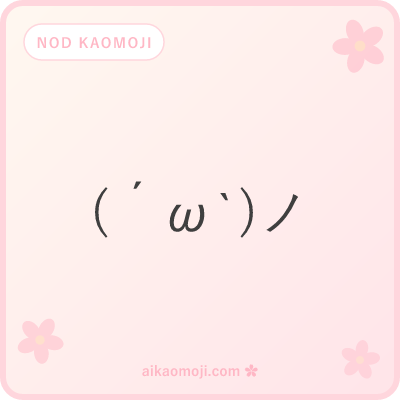
General nod register — (´ω`)ノ soft hand-raised, (・_・)ゞ scratch-bow, (・∀・)ノ agreeing, (⌒‿⌒) closed-eye acknowledgment.
The fallback bucket holds the everyday nodding shapes. (´ω`)ノ is the canonical soft-eye + raised-hand form — the plain "got it" reply. (・_・)ゞ uses the ゞ back-scratch gesture for a slightly bashful nod. (⌒‿⌒) closes the eyes in peaceful arch-agreement. The order-swap kaomoji nod variant folds into this same bucket — same gesture, same use.
Head Nod Kaomoji
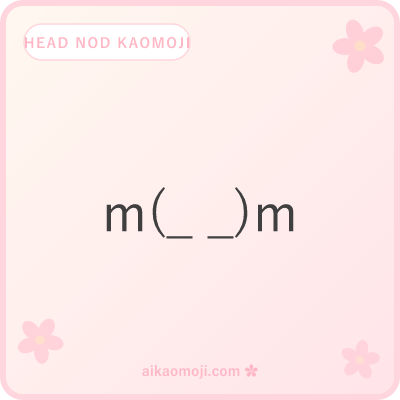
Formal head-tilt register — m(_ _)m Japanese dogeza bow, (o_ _)o formal head-down, ( _ _)ノ tilt-hand.
A head nod kaomoji pushes into formal-respectful acknowledgment. m(_ _)m is the classic dogeza — text-based Japanese kneeling bow with hands pressed to the floor, used for sincere apology or deep gratitude. (o_ _)o strips the lowercase m for a lighter formal bow. ( _ _)ノ tilts the head down with a raised hand for engaged agreement. When "acknowledged" needs to signal respect, this is the register.
Nod Kaomoji FAQ
Quick answers on nod vs agree vs thumbs-up, the m(_ _)m dogeza bow meaning, and when to add a ✓ check mark.
How do I copy nod kaomoji?
One tap and the acknowledging nod is on your clipboard. Nod kaomoji work as a Slack reply confirming a task, a Discord reaction agreeing with a friend, a Twitter quote-tweet nodding to a good take, or a formal chat-message acknowledgment. The most-copied form stays (´ω`)ノ — a soft ω-mouth face with a raised katakana ノ hand reading universally as "got it, agreeing" without any caption needed. Paste with Ctrl+V (Windows) or ⌘+V (Mac).
How is nod kaomoji different from agree kaomoji or an emoji thumbs up?
Different register, different intent. Nod kaomoji signal ACKNOWLEDGMENT through a physical gesture — the hand-raised ノ or the head-tilt-down (_ _) pattern — reading as "I understood, I am with you." Agree kaomoji (a separate keyword cluster) signal ASSENT to a position with faces like (๑•̀ㅁ•́๑)✧. A thumbs-up emoji 👍 is faster but reads more casual. Practical rule: use nod kaomoji when you want to signal engaged acknowledgment (I'm nodding along), agree kaomoji for explicit yes-position, and thumbs-up for a quick low-effort ack.
What does the m(_ _)m Japanese bow pattern actually mean?
The m(_ _)m shape is a text-based dogeza — a deeply respectful Japanese bow where you kneel and press your forehead to the floor. The lowercase m characters on both sides represent the closed hands / arms of someone bowing; the (_ _) represents the head-down face with closed eyes. In text chats, m(_ _)m is used for either sincere apology, deep gratitude, or extra-respectful acknowledgment. It carries more weight than a casual (´ω`)ノ nod — reserve it for moments that warrant real formality.
When should I add the ✓ check mark to a nod kaomoji?
The ✓ suffix (like (・_・)ゞ✓ or (´ω`)ノ✓) turns a plain nod into an explicit "agreed and confirmed" signal. Use it in async work chats where you want the acknowledgment to double as task-confirmation — for example, when a Slack thread asks "can everyone confirm they got this" and you want your reply to visibly say both "nodding" and "done, checked off." Without the ✓, the nod reads as passive acknowledgment. With it, the nod reads as active-confirmed action.
Can the AI generator create custom nod kaomoji?
Yes — scroll to the top and describe what you want. Try prompts like "acknowledging nod reply for a Slack task confirmation", "formal Japanese bow for a sincere apology message", "casual nod-along for a Twitter quote-tweet". The generator returns 6 fresh nod kaomoji per prompt, ready to copy in one tap. Free, no signup, powered by Google Gemini 2.5 Flash.
Replying to a Slack thread where the answer is just "on it"? A (´ω`)ノ says everything a paragraph would. For a Discord friend confirming plans, (⌒‿⌒) reads as closed-eye satisfied-agreement without needing words.
Writing an apology in a work chat that needs to signal real sincerity? m(_ _)m carries formal weight — text dogeza reads as "I take responsibility." For a lighter bow, (o_ _)o still signals respect without going full formal.
Confirming an async task in a busy channel? (・_・)ゞ✓ combines the acknowledging bow with an explicit check mark — both nodding and checking off. The AI generator up top spins fresh nod variants — describe the acknowledgment mood, get six nodding faces back tuned to the tone.
Every live category on aikaomoji in one place — counts, thumbnails, and roadmap for what's coming next.
Open the kaomoji list