(≧∇≦) Laughing Kaomoji
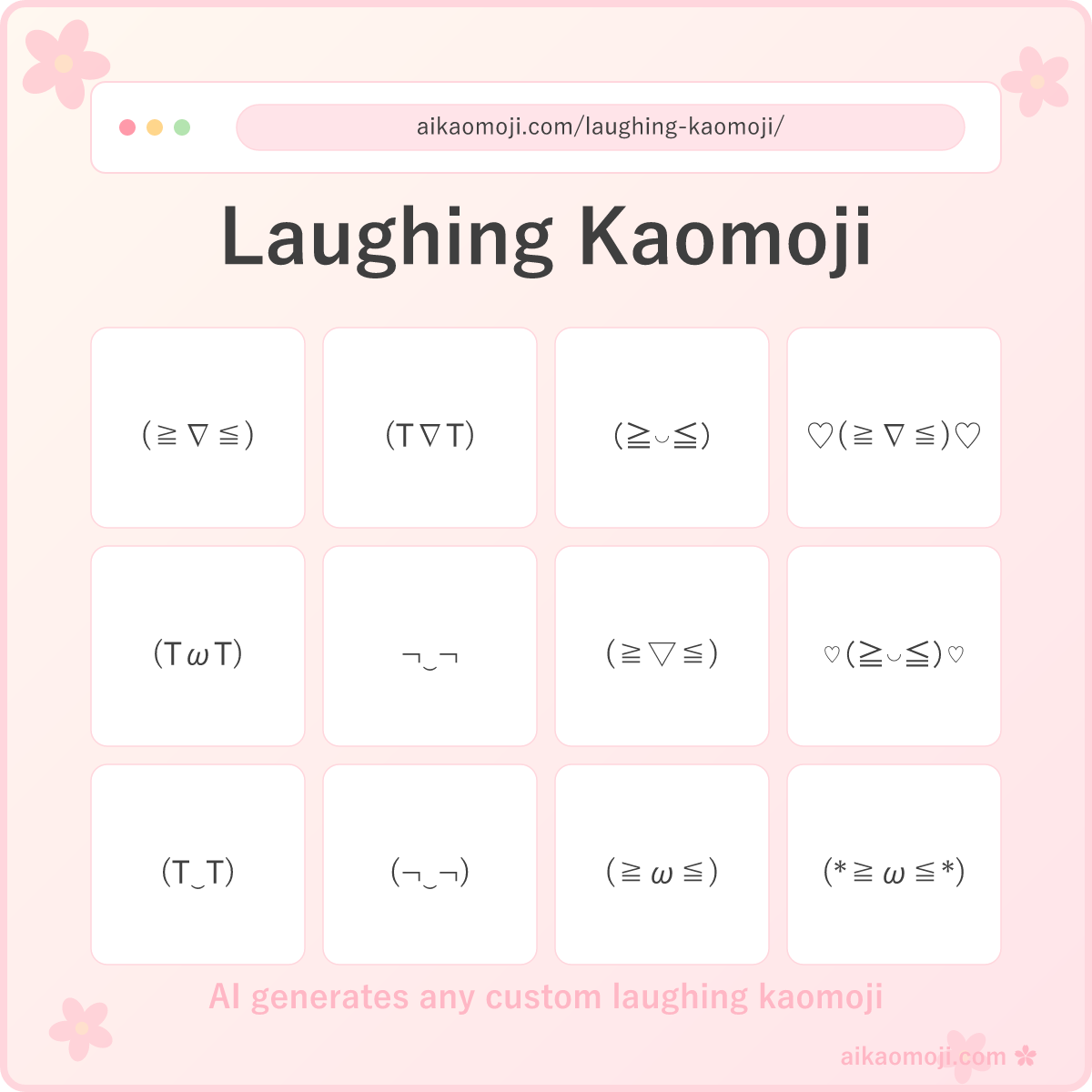
A laughing kaomoji is a burst, not a smile. The eye characters go tight and closed — ≧ paired with ≦, > paired with <, or T paired with T for the classic 笑到哭 laughing-to-tears look. Between the closed eyes sits an open-mouth char: ∇ ▽ ω ∀ д — the wider the character, the harder the laugh. (≧∇≦) is the version everyone reaches for. Plain Unicode text, no image upload, no font install.
Four moods split the library. Kaomoji laugh is the fallback for plain (≧∇≦) squint faces with no deco — also the home for the Japanese w and www chat-laugh onomatopoeia that reads as 'lol' in Japanese internet culture. Crying laughing kaomoji swap the ≧ ≦ eyes for T-shaped tears while keeping the squint-shape — 笑到哭, laughing so hard you cry. Cute laugh kaomoji stack ♡ ★ ✧ around the same squint face for a kawaii cute-laughter register. Evil laugh kaomoji use ¬ narrowed eyes or ⌐■_■ sunglasses for the villain-cackle read that's perfect for smug replies and 'I told you so' moments.
The AI generator at the top spins a fresh laughing kaomoji from any prompt in a second or two — ask for a crying-laughing reaction to a viral tweet, a kawaii cute laugh for a wholesome DM, an evil laugh for a smug reply, or a plain (≧∇≦) for a group chat. Describe the vibe, get six variants back. Awkward laugh, nervous laugh, and sarcastic laughing variants also fold in through the same prompt shape.
Everything here is plain Unicode, so a paste from any card lands identically on iOS, Android, macOS, Windows, and the usual chat apps. For a calm content smile without the burst-squint — that's a different mood — the happy kaomoji page handles those separately. For pure sad tears without the laugh, the crying kaomoji page has T_T faces without the open mouth. This page stays on the burst-laugh side: plain, crying-laughing, cute, or evil.
Kaomoji Laugh
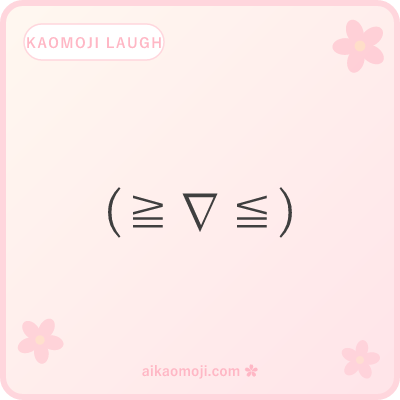
Plain squint big-laugh — (≧∇≦) canonical, (≧◡≦) smile-close, (≧▽≦) triangle, (>_<) cross-eye, (≧ω≦) omega, (≧∇≦)www Japanese w laugh.
The plain-and-simple laugh bucket — squint-closed eyes on both sides, an open-mouth character between them. (≧∇≦) is the canonical version everyone recognizes; (≧◡≦) softens the closed eye with a small smile-curve; (≧▽≦) uses a filled triangle mouth for a wider laugh; (>_<) drops the ≧ ≦ for the more compact >< pair; (≧ω≦) swaps in the omega mouth for a kawaii mid-laugh feel. Japanese internet culture stacks w or www after the face — (≧∇≦)www reads as 'lol lol lol' in Japan the same way English speakers use 'haha' or 'lmao'. The Japanese haha kaomoji spelling with ワラ or ハハハ katakana lives here too.
Crying Laughing Kaomoji
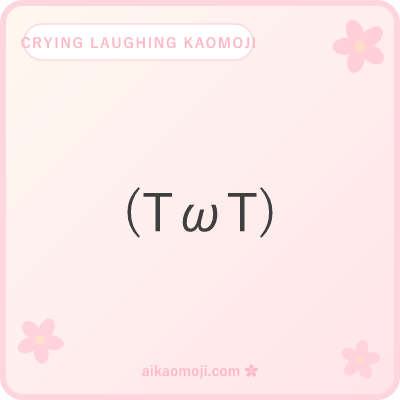
Laughing to tears — (TωT) omega mouth, (T∇T) triangle wide, (T‿T) undertie, ( ; ∀ ; ) semicolon tears, (╥∇╥) box-drawing, ╰(TдT)╯ arms up.
Crying laughing kaomoji keep the squint mouth-open shape of the plain laugh bucket but swap the ≧ ≦ eyes for T-shaped tears — the 笑到哭 emoji-equivalent of laughing so hard you're crying. (TωT) is the softest, using an omega mouth that reads as sustained laughing; (T∇T) opens the mouth wider for a bigger burst; (T‿T) uses an undertie smile-mouth for a warmer tearful chuckle; ( ; ∀ ; ) trades in semicolons for smaller quieter tears; (╥∇╥) uses box-drawing char for the anime-style ugly-cry laugh. The order-swap variants — kaomoji crying laughing, kaomoji laughing and crying, laughing while crying kaomoji — all point at this same 笑到哭 combo.
Cute Laugh Kaomoji
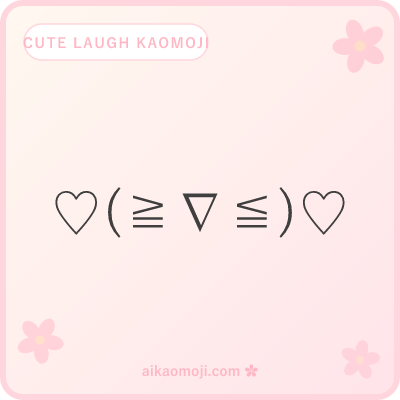
Kawaii deco laugh — ♡(≧∇≦)♡ heart flank, (*≧ω≦*) asterisk enclose, ★(≧∇≦)★ star flank, ✧(≧∇≦)✧ sparkle, ♡\(≧∇≦)/♡ arms + heart.
Cute laugh kaomoji layer kawaii deco on top of the same squint burst-face — the version you send when the laugh comes with warmth. ♡(≧∇≦)♡ frames the face with hearts on both sides for a 'this made my day' send; (*≧ω≦*) uses asterisks as a kawaii enclosure that reads as a softer giggle; ★(≧∇≦)★ swaps stars for a brighter celebratory laugh; ✧(≧∇≦)✧ uses four-point sparkles for a lighter cuter deco; ♡\(≧∇≦)/♡ combines arms-up with heart flank for the maximum-cute burst. Good for wholesome-post replies, close-friend DMs, and anime-fandom captions.
Evil Laugh Kaomoji
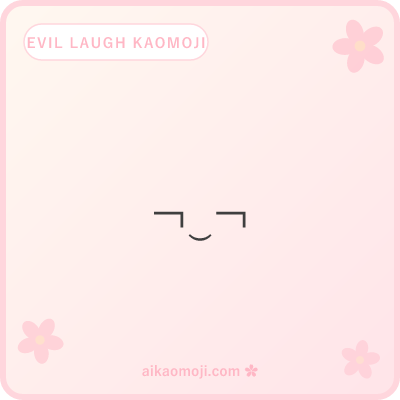
Villain cackle — ¬‿¬ canonical smug, (¬_¬) narrowed, 凸(¬‿¬) arms-out, (⌐■_■) sunglasses, ˘Q˘ Q-mouth evil, (¬з¬) mouth-flick.
Evil laugh kaomoji use narrowed ¬ eyes and villain accessories for the smug-cackle register — the 'muhaha' reaction. ¬‿¬ is the canonical version, with two ¬ narrowed eyes and a mischievous ‿ smile between; (¬_¬) closes the smile to a flat line for pure narrowed suspicion; 凸(¬‿¬) adds the 凸 middle-finger arm for the aggressive villain send; (¬‿¬)凸 trails it for the after-move; (⌐■_■) swaps in sunglasses (Reversed Not Sign ⌐ and Black Square ■) for the 'deal with it' meme energy; ˘Q˘ uses a Q-shaped tongue-out mouth for the 'nyeh heh heh' cartoon-villain read. Sarcastic laughing variants also live here.
Laughing Kaomoji FAQ
Quick answers on the Japanese w laugh onomatopoeia, laughing vs happy, and building your own from a keyboard.
How do I copy laughing kaomoji?
One tap and the (≧∇≦) squint is on your clipboard. Laughing kaomoji fit anywhere a plain 😂 emoji would feel too flat — the 'this is hilarious' reply to a group-chat joke, the 'lol I can't' reaction to a screenshot, the tears-of-laughter DM after inside-joke banter. The most-copied variant is (≧∇≦) — two squinted-shut eyes flanking an open ∇ mouth. Every card is plain Unicode text, so it renders identically on iOS, Android, Windows, macOS, Discord, iMessage, Slack, and Instagram. Paste with Ctrl+V (Windows) or ⌘+V (Mac).
What does the w or www at the end of a laughing kaomoji mean?
The w is Japanese internet slang for laughter — short for 笑 (warai, meaning laugh). Japanese chatters started dropping w after messages to signal amusement, the same way English speakers type lol. Multiple w's stack for stronger laughter — www is a solid chuckle, wwww is a big laugh, and wwwwww trailing off is the equivalent of dying-laughing. When you see (≧∇≦)www in a Japanese chat context, read it as 'lol lol lol' with the visual kaomoji doing the heavy lifting for facial expression. In North American chats, people occasionally borrow this without knowing the origin — treating the w's as 'grass growing' (which is a joke folk-etymology: rows of w's look like grass sprouting).
What's the difference between laughing kaomoji and happy kaomoji?
Happy kaomoji signal calm contentment — eyes gently curved like ‿ or ◡, mouth slightly upturned, no burst intensity. Examples: (◕‿◕), (´∀\`), (^▽^). Laughing kaomoji signal a burst reaction — eyes forced completely closed by the laugh, often shown as tight ≧ paired with ≦ or > paired with <, and the mouth thrown wide open (∇ ▽ ω ∀). Examples: (≧∇≦), (>ω<), (≧◡≦). Rough rule: if the eyes look relaxed and open, it's happy; if the eyes look squeezed shut by intensity, it's laughing. This page focuses on burst-laugh variants; the happy kaomoji page handles calmer smile faces.
How do I type a laughing kaomoji from my keyboard?
Build a laugh piece by piece: (1) start with brackets ( ) around the face; (2) type a squint-closed eye character on the left — ≧ is the fastest (Mac: option+, or copy from a card; Windows: Character Map, subset 'Mathematical Operators'; iPhone: Unicode character keyboards); (3) type an open-mouth character in the middle — ∇ ▽ ω or ∀ all work, use ω if you want a kawaii softer laugh; (4) type ≦ on the right (the mirror of ≧); (5) close the bracket. Full pattern: ( ≧ ∇ ≦ ) which reads as (≧∇≦). To add the Japanese w laugh, just type w or www after the closing bracket. Fastest route: copy any card here and swap the mouth char to match your intended intensity.
Can the AI generator create custom laughing kaomoji?
Yes — scroll to the top and describe what you want. Try prompts like "crying-laughing reaction to a viral tweet", "kawaii cute laugh for a wholesome DM", "evil laugh for a smug reply". The generator returns 6 fresh laughing kaomoji per prompt, ready to copy in one tap. Free, no signup, powered by Google Gemini 2.5 Flash.
A quick note on the squint pattern: kaomoji artists picked the ≧ ≦ pair (Mathematical Operators U+2267 and U+2266) because at kaomoji scale the two shapes look exactly like eyes forced shut by a burst of laughter. Combined with a wide open-mouth character (∇ ▽ ω ∀ д), the whole face reads as a burst reaction rather than a calm smile. That's what separates a laugh kaomoji from a happy kaomoji.
A map of neighbors: for calm content-smile faces without the burst-squint, the happy kaomoji page handles those. For pure sad tears without the laugh, crying kaomoji has T_T faces with no open-mouth. For arms-up burst celebration variants that lean more 'excited' than 'laughing', the excited kaomoji page carries the \(´∀`)/ pose family.
Awkward laugh, nervous laugh, and sarcastic laughing variants each carry the squint shape but add a small sweat drop or a wavier mouth to signal the modifier — those sit in the Kaomoji Laugh bucket for awkward/nervous, and in Evil Laugh for sarcastic. Every laughing kaomoji copy and paste from a card here works on Discord, iMessage, Slack, iPhone, Android, macOS, Windows, Instagram, TikTok, and Reddit. Bookmark the URL, come back next time you need a (≧∇≦) burst reply.
Every live category on aikaomoji in one place — counts, thumbnails, and roadmap for what's coming next.
Open the kaomoji list