><((('> Fish Kaomoji
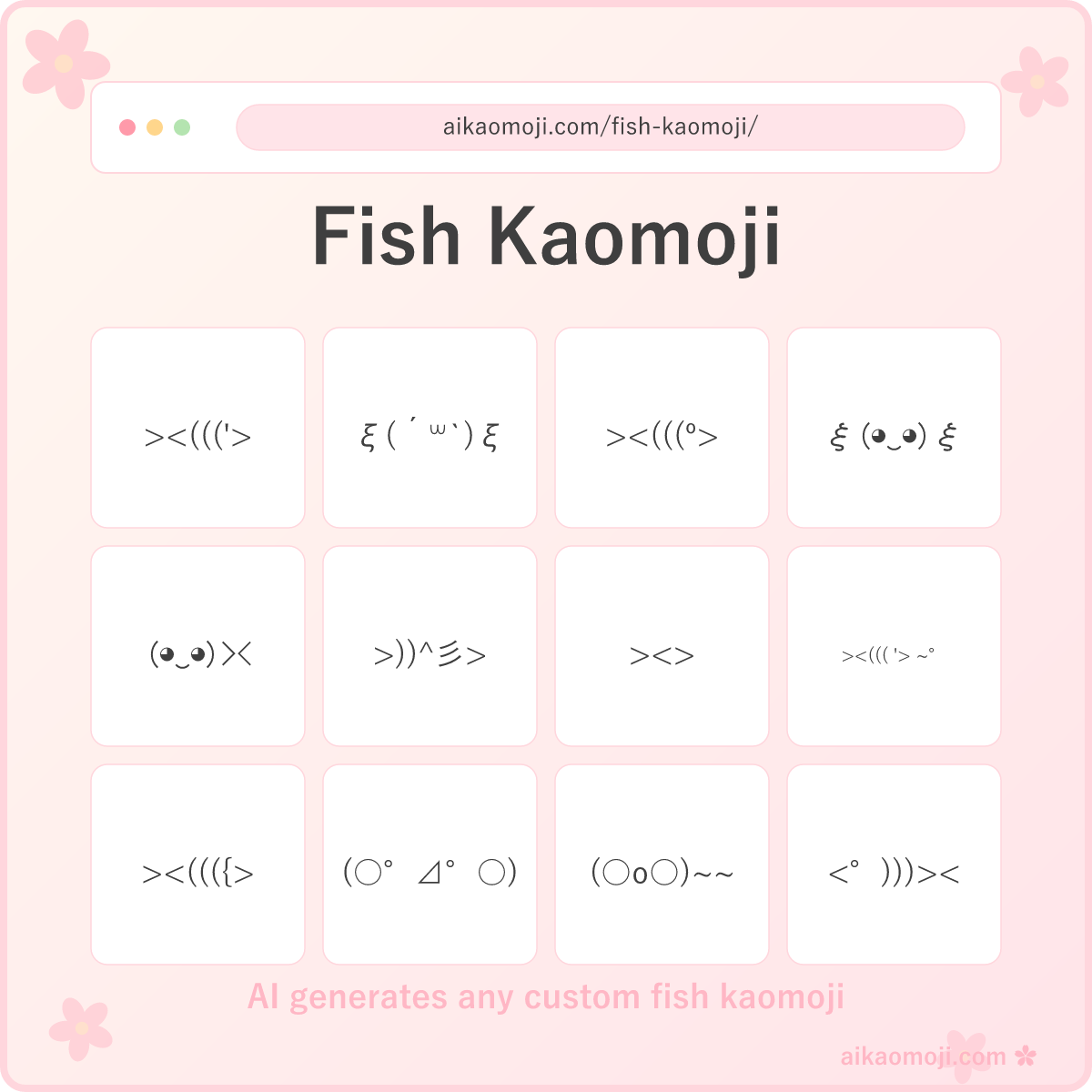
Fish kaomoji is one of the oldest emoticon families around — pure ASCII made from angle brackets, parentheses, and an apostrophe tail. ><((('> is the shape most people copy first, unambiguous enough to still read as a fish on any keyboard-only device. The kaomoji fish tradition traces back to Usenet in the early 90s, where terminal-only text limited every image to what a keyboard could type — the classic ><((('> was born there and has stayed unchanged for 30+ years.
Jellyfish drifts through the collection with ξ Greek xi tentacles wrapped around a soft face like ξ(´꒳`)ξ. The Japanese koi tradition uses 彡 or ミ as a motion-body pattern layered on top of the angle-bracket silhouette. Puffer fish rounds up when the base gets ‡ double-dagger spikes and a round body like (○°⊿°○). Fish bones live in the dead-fish register with skeleton dashes like <°]-]-]< and x-eye markers. And swimming fish adds bubble trails ~° and wave ripples ≈≈≈ on top of the base silhouette to imply motion.
The AI generator at the top spins a fresh fish kaomoji from any prompt in a couple seconds. Ask for a shiny koi swimming upstream, a puffed-up angry fugu, or a swimming school with bubble trails — describe the scene, get six variants back. A fish kaomoji copy paste from any card sends plain Unicode straight to the clipboard, so it renders identically on Discord, iMessage, Instagram, Notion, Twitter, and every browser.
Every card is plain text, not an image asset — the same fish kaomojis copy straight to a Slack status, a Twitter bio, or a Discord server rules doc. Adjacent sea themes like aquarium tanks and ocean waves stay on their own future URLs, so this page stays inside the fish silhouette register.
Jellyfish Kaomoji
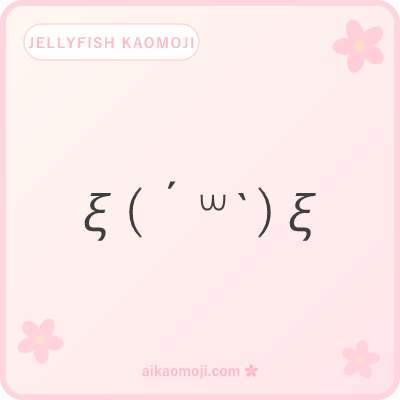
Soft round face with ξ Greek xi tentacles or ~~~ trailing pattern — drifting cnidarians in the fish silhouette family.
Jellyfish kaomoji uses ξ (Greek small letter xi, U+03BE) as tentacles wrapping around a kawaii face. The canonical ξ(´꒳`)ξ pairs a triangle-mouth soft face with a symmetric pair of tentacles, and variants swap the face content for big-eye ξ(◕‿◕)ξ, kawaii cheek ξ(*ˊᵕˋ*)ξ, or drop the xi entirely for ~~~ trailing tentacles like (○o○)~~. When the AI generator gets asked for a floating jelly, this is the pattern it lands on.
Kaomoji Fish
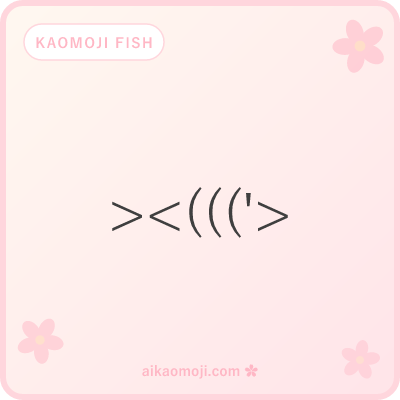
The classic ASCII silhouette register — angle-bracket head, parenthesis body, apostrophe or angle tail.
Every kaomoji fish variant sits on the same three-part skeleton: an angle-bracket head, a parenthesis (or curly-brace) body, and an apostrophe or angle-bracket tail. ><((('> is the canonical version, and the buckets here cover dot-eye ><(((º>, curly tail ><((({>, thick tail ><((>=<, reversed swim <°)))><, and school-pair combos. Nothing extra, nothing kawaii — pure silhouette. If a fish kaomoji copy paste is going into a plaintext email or a terminal chat, this is the register.
Cute Fish Kaomoji
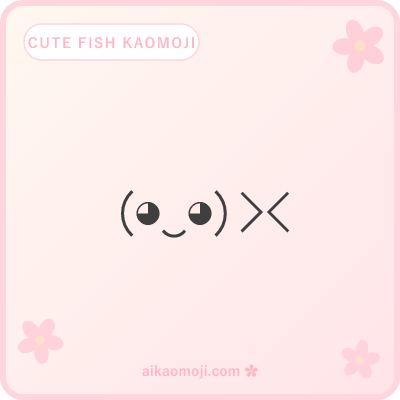
Kawaii round-eye face paired with a fish tail marker — soft version of the ASCII fish.
When a fish kaomoji picks up a kawaii face, it lands here. (◕‿◕)>< pairs a big-eye smile with a fish tail, (^ω^)>< uses the omega mouth, (っ˘ω˘)っ><> adds cuddle arms and a bidirectional tail, and ><( º ᴥ º)> uses the ᴥ Phonetic bunny-nose glyph inside a full ASCII fish silhouette. This section is where a fish kaomoji cute search resolves — face-forward, tail attached, soft on both sides.
Koi Fish Kaomoji
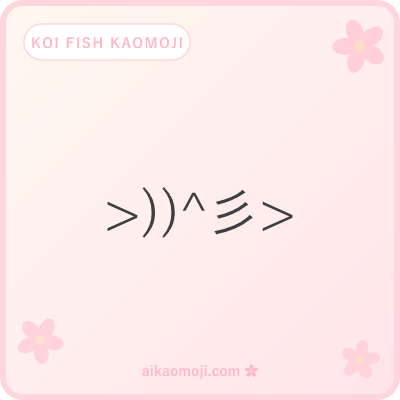
Japanese ornamental fish with 彡 (CJK) or ミ (Katakana) as the flowing motion body pattern.
A koi fish kaomoji swaps the standard parenthesis body for 彡 (CJK U+5F61) or ミ (Katakana MI) — both read visually as flowing water-lines and echo the way traditional Japanese ink art draws the koi's swimming curve. >))^彡> is the canonical koi shape, and variants extend the tail with >)))彡, add a soft face with (´ω`)彡>, or attach a sparkle for the pond-reflection effect like ><彡°゚✧. If the search intent is Japanese-flavored, this is the section.
Fish Bone Kaomoji
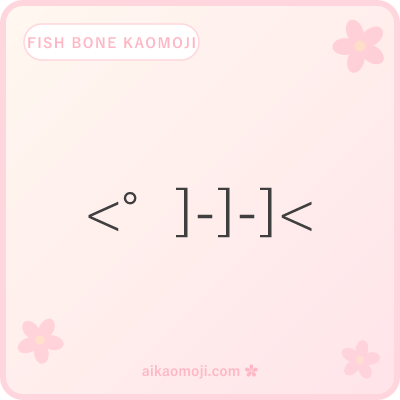
The dead-fish register — skeleton dashes, x-eye markers, and bare bone-only silhouettes.
A fish bone kaomoji strips the silhouette down to just the skeleton. ><> is the minimal one-line bone, <°]-]-]< adds explicit ribs with ]-]-]-] repeats, ><((|-|-|-|>< uses vertical bar segments for a full skeleton, and x><> or X_X><> marks the fish as dead with x-eye or cross-out markers. This section covers dead-fish reaction jokes, sushi menu vibes, and the classic drought-and-death fish bone visual gag.
Fish Swimming Kaomoji
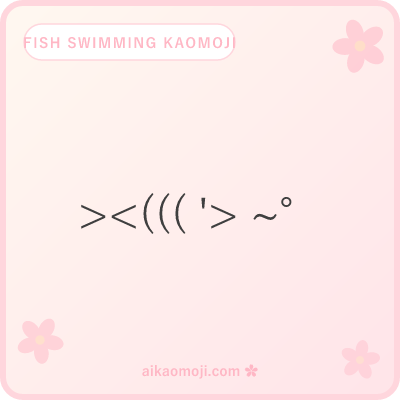
Motion register — bubble trails ~°, wave ripples ≈, and lead-lines suggesting an ASCII fish in motion.
A fish swimming kaomoji adds motion markers on top of the base silhouette. ><((( '> ~° trails single bubbles behind the fish, ><((º> ○ ~ shows bubbles rising above, ><((( '>≈≈≈ uses wave ripples for a horizontal swim, and .><((( '> ~ leads with a swim-line dot. This is the section where a fish kaomoji swimming feels alive rather than static — every entry implies direction and speed.
Puffer Fish Kaomoji
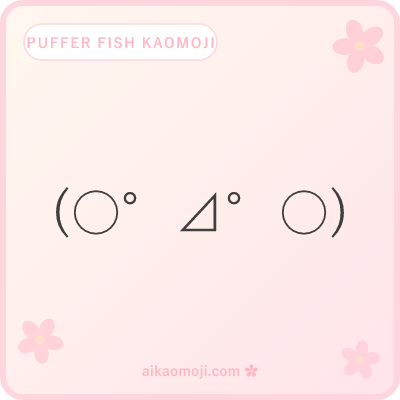
Round spherical body with ‡ double-dagger, ⊿ triangle, or asterisk * spike markers — the puffed-up fugu.
A puffer fish kaomoji rounds the base silhouette up into a defensive ball with spikes. (○°⊿°○) uses ⊿ triangle spikes with round-body brackets, <(‡ᴥ‡)> puts ‡ double-dagger spikes around a Phonetic nose face, (>*<) is the minimal puffed-defensive read, and ‡( °ω° )‡ frames a startled omega face with double-dagger spikes on both sides. When the search intent is fugu or defensive-fish, this section catches it.
Fish Kaomoji FAQ
Quick answers on the classic ASCII fish, where it came from, and how jellyfish and koi fit in.
How do I copy fish kaomoji?
One tap and the classic ASCII fish is on your clipboard. Fish kaomoji work in Twitch chat during a fishing stream, in a Discord bio for an angling server, on Twitter around National Fishing Day, or in a Slack channel where someone just landed a metaphorical catch. The most-copied variant is the classic ><((('> — three-decade-old ASCII that renders identically on every device from a Nokia dumbphone to a MacBook. Paste with Ctrl+V (Windows) or ⌘+V (Mac).
What does ><((('> actually mean and where did it come from?
><((('> is the classic ASCII fish emoticon, built from left to right: >< is the head (or fins), ((( is the body scales, and '> is the tail. It emerged on Usenet in the early 1990s along with the whole IXOYE Christian-fish text-art tradition, and became one of the most reused emoticons on IRC, forum signatures, and early web guestbooks. The fish kaomoji meaning has stayed the same since — a playful shorthand for anything nautical, aquatic, fishy-suspicious, or simply cute. Modern variants tweak the eye (><(((º>), tail (><((({>), or add motion trails (><((( '> ~°), but the core shape is unchanged.
What is the difference between koi kaomoji and regular fish kaomoji?
A regular fish kaomoji uses parentheses ((( as the body — flat scales, no motion. A koi kaomoji swaps the parentheses for 彡 (CJK U+5F61) or ミ (Katakana MI), which visually reads as a flowing motion-line — the traditional way Japanese artists draw the elegant curve of a koi's swim. So >))^彡> is a koi, but >)((( '> is a regular fish. Koi kaomoji also tends to have a sparkle or ✧ decoration around it (>))^彡> ✧°゚) because koi are prized ornamental fish in Japanese ponds — the sparkle mirrors how they catch sunlight through water.
Are jellyfish kaomoji technically fish?
Biologically, no — jellyfish are cnidarians, not fish (they don't have bones, fins, or a proper spine). But in kaomoji classification, jellyfish share the same aquatic-creature space and use the same construction principles: a face wrapped in tentacles built from ξ (Greek small letter xi, U+03BE) or ~~~ trailing patterns. That's why ξ(´꒳`)ξ lives on this page rather than in a separate spot — the shared visual vocabulary keeps them together. If the AI generator ever surfaces a demand for a dedicated jellyfish page, it can split off cleanly.
Can the AI generator create custom fish kaomoji?
Yes — scroll to the top and describe what you want. Try prompts like "a shiny koi swimming upstream with sparkles", "a puffed-up angry fugu with spikes", "a swimming school with bubble trails". The generator returns 6 fresh fish kaomoji per prompt, ready to copy in one tap. Free, no signup, powered by Google Gemini 2.5 Flash.
Building a Twitter thread on fishing tips? Fish kaomoji text copies cleanly into every editor, and the fish symbol kaomoji shape stays intact whether the reader is on iOS, Android, or web. A single ><((('> next to a headline reads as a fishing context signal instantly.
Setting up a pet-fish Instagram bio? Fishbowl kaomoji vibes come from wrapping a small fish inside curved brackets like (~ ><((('> ~) — the tank border implied without spelling it out. For the fishing-scene version, the classic \( ˘ᴥ˘)/|~~ sets up a rod and line without needing an explicit fishing kaomoji.
Building a marine-themed Discord server? Starfish kaomoji often gets grouped with fish because of the shared word — a simple (☆・ω・)☆ variant sits comfortably next to the ><((('> classic. If you need a full ASCII decorated frame, the AI generator can produce fresh combinations layered with 。゚+.゚。 sparkle cascades in seconds.
Every live category on aikaomoji in one place — counts, thumbnails, and roadmap for what's coming next.
Open the kaomoji list