m(_ _)m Bowing Kaomoji
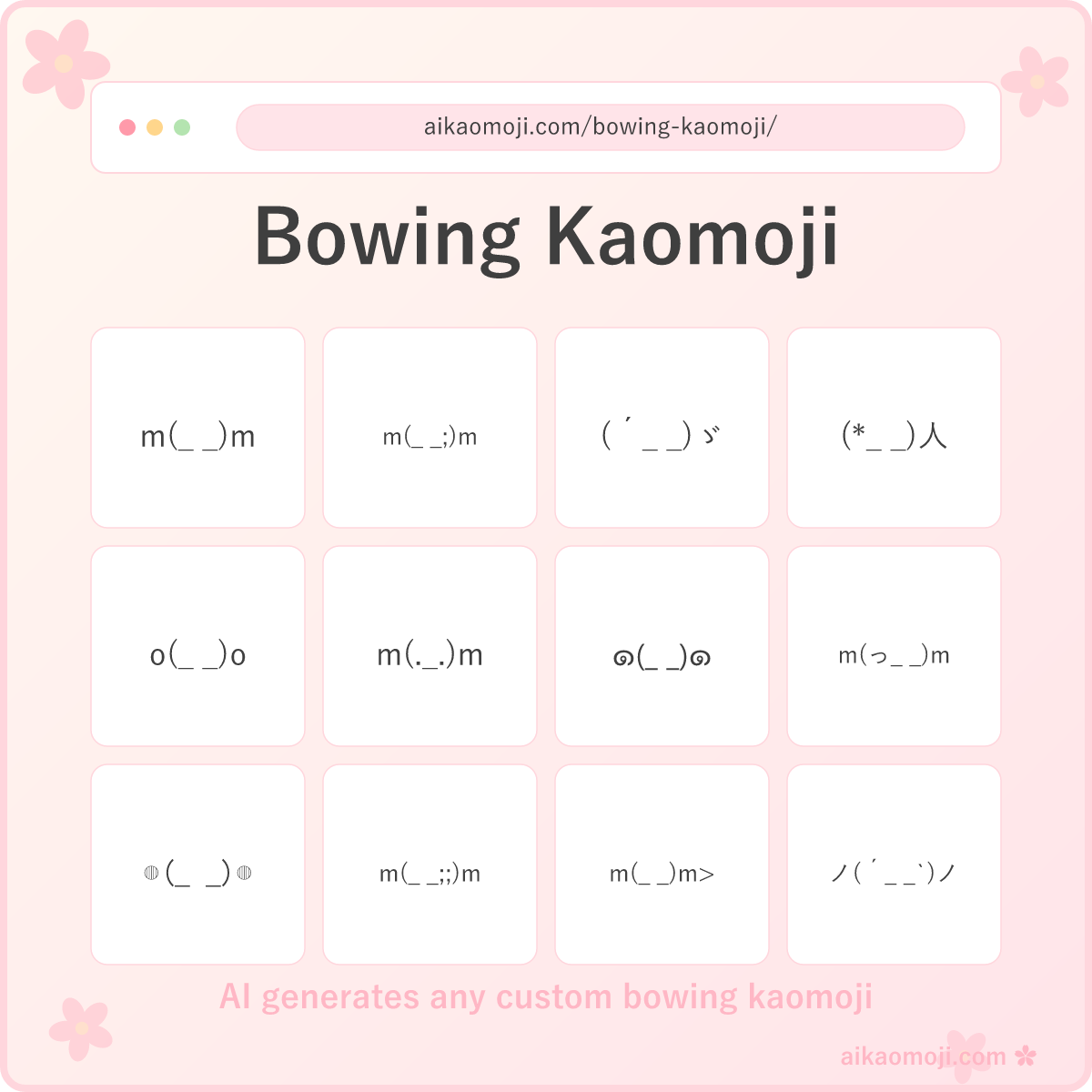
Bowing kaomoji cover the respect-apology-gratitude gesture moment — a Slack apology after missing a meeting, a Discord thank-you to a helpful mod, a formal Japanese-context email sign-off. The canonical bowing kaomoji is m(_ _)m — two lowercase m's function as clasped hands with a bent-forward closed-eye face in the middle reading instantly as "I'm bowing to you." One bowing kaomoji lands the humility signal without needing a paragraph of "sorry" or "thank you."
The bowing kaomoji library here splits four ways. Kaomoji bowing covers the general apology and gratitude bows — m(_ _)m, m(_ _;)m sweat-apology, (´_ _)ゞ hand-salute, (*_ _)人 clasped-hands pleading. Kaomoji bowing down pushes deeper into forward-lean dogeza territory — m(_ _)m>, m(_ _;)m> with arrow direction, m(◞‸◟)m hangdog-heavy. Person bowing kaomoji uses full-body brackets around the bow — ノ(´_ _`)ノ, ⌒(_ _)⌒, ヽ(_ _)ノ, ᕕ(_ _)ᕗ. Japanese bowing kaomoji layers cultural context words — ぺこりm(_ _)m pekori, m(_ _)m 失礼 shitsurei, m(_ _;)m すみません sumimasen.
The m ... m hand-bracket around (_ _) face is doing all the visual work. The two lowercase m characters function as clasped fists on either side; the (_ _) inside reads as closed eyes with a downward-tilted mouth — the entire structure mimics the Japanese dogeza posture of forehead-to-floor formal bow. Add ; sweat for anxious-apology, > arrow for deeper forward-lean, ぺこ pekori Hiragana for the culturally-specific formal Japanese bow. The face-plus-hand-bracket combination is one of the most recognizable kaomoji patterns in the vocabulary — Japanese chat users have used it since the 90s as the standard "I'm sincerely bowing" gesture.
The AI generator up top spins a fresh bowing kaomoji from any prompt — a Slack apology for missing a stand-up, a Discord thank-you after a mod helps you out, a formal Japanese-context sign-off, a bio joke about being permanently sorry for existing — in a few seconds. A bowing kaomoji copy and paste from any card sends plain Unicode to your clipboard, ready to bow anywhere.
Kaomoji Bowing
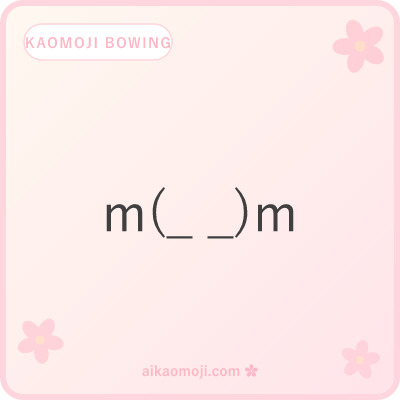
General bow register — m(_ _)m dogeza classic, m(_ _;)m sweat apology, (´_ _)ゞ hand salute, (*_ _)人 clasped hands.
The general kaomoji bowing bucket holds the everyday apology and gratitude bows. m(_ _)m is the canonical dogeza — two lowercase m's as clasped fists around a closed-eye bent-forward face. m(_ _;)m adds a semicolon sweat drop for anxious-apology. (´_ _)ゞ swaps to a hand-salute using Katakana ゞ for the humble-respect register. (*_ _)人 mounts CJK 人 (person) as clasped-hand marker for the pleading-gratitude register.
Kaomoji Bowing Down
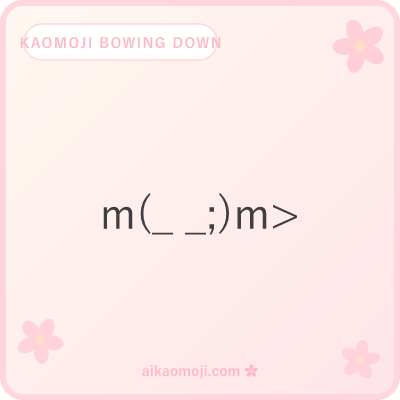
Deep-forward register — m(_ _)m> arrow direction, m(_ _;)m> deep sweat, m(◞‸◟)m hangdog, m(-_-)m tight apology.
A kaomoji bowing down pushes deeper into forward-lean dogeza territory. m(_ _)m> adds a rightward arrow indicating the deep-bow motion. m(_ _;)m> combines sweat with arrow direction for the anxious-deep-bow. m(◞‸◟)m uses hangdog eye markers ◞◟ for the truly-defeated humble-apology look. m(-_-)m uses hard-line dash eyes for the tight-serious-apology register. When the standard m(_ _)m isn't deep enough.
Person Bowing Kaomoji
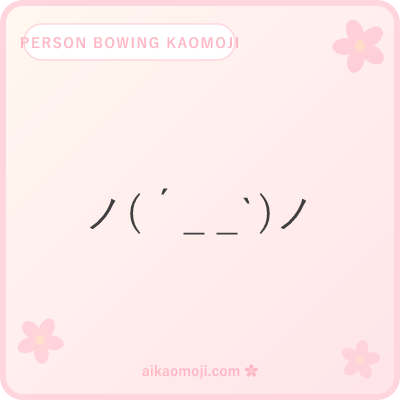
Full-body standing bow — ノ(´_ _`)ノ full body, ⌒(_ _)⌒ arch bow, ヽ(_ _)ノ walking bow, ᕕ(_ _)ᕗ syllabics standing.
A person bowing kaomoji uses full-body brackets around the bow face for a standing-figure gesture. ノ(´_ _`)ノ uses double Katakana ノ brackets for full-body pose. ⌒(_ _)⌒ uses arch ⌒ brackets for the bent-torso silhouette. ヽ(_ _)ノ uses walking-arm Katakana brackets for the mid-walk bow. ᕕ(_ _)ᕗ swaps in Canadian Aboriginal Syllabics for the viral standing-figure look. When the bow needs a whole-body-visible rather than just face-and-hands.
Japanese Bowing Kaomoji
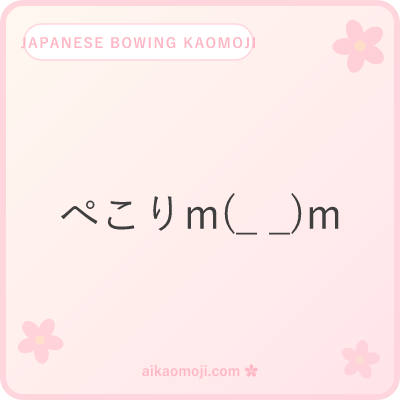
Traditional formal bow — ぺこりm(_ _)m pekori, m(_ _)m 失礼 shitsurei, m(_ _;)m すみません sumimasen, ぺこぺこm(_ _)m triple.
A Japanese bowing kaomoji layers cultural context words with the standard m(_ _)m dogeza. ぺこりm(_ _)m combines the pekori onomatopoeia with the deep bow for a warm-Japanese-casual register. m(_ _)m 失礼 (shitsurei) adds the formal "excuse me" phrase for business-Japanese context. m(_ _;)m すみません (sumimasen) uses the formal apology phrase with sweat for anxious-apology. ぺこぺこm(_ _)m stacks multiple pekori for the extra-emphatic humble-repeat bow. When the bow specifically wants Japanese cultural signal.
Bowing Kaomoji FAQ
Quick answers on the m(_ _)m dogeza meaning, bowing vs the ribbon bow, and Japanese ぺこり pekori cultural context.
How do I copy bowing kaomoji?
One tap and the m(_ _)m bow is on your clipboard. Bowing kaomoji work as a Slack apology after missing a meeting, a Discord thank-you to a helpful mod, a formal Japanese-context email sign-off, or a group-chat sincere-sorry after a misunderstanding. The most-copied form stays m(_ _)m — two lowercase m's as clasped hands with a closed-eye bent-forward face reading universally as "I'm bowing to you" across any language chat. For anxious-apology, add sweat ; — m(_ _;)m — for the extra-sincere register. Paste with Ctrl+V (Windows) or ⌘+V (Mac).
What does bowing kaomoji m(_ _)m actually mean?
m(_ _)m is a text approximation of the Japanese dogeza (土下座) posture — a formal deep bow where the person kneels and touches their forehead to the floor. The two lowercase m characters on either side function as clasped fists (visualized as the person's hands pressed to the ground); the (_ _) in the middle shows a bent-forward closed-eye face — the underscores are eyes shut in humility, the parentheses hint at a lowered mouth. Together the pattern reads as "I am fully bowing to you" — the strongest apology or gratitude signal in the kaomoji vocabulary. Use it for sincere sorry, sincere thank-you, or formal humble-request scenarios where a plain (´_ _`) wouldn't carry enough weight.
How is bowing kaomoji different from bow kaomoji (the ribbon)?
Completely different meanings and visuals. Bowing kaomoji (this page) uses (_ _) closed-eye face structure with hand brackets m ... m for the respect-apology-gratitude gesture — m(_ _)m dogeza, m(_ _;)m sweat apology. Bow kaomoji (the ribbon page at /bow-kaomoji/) uses decoration characters like ⋆⁺₊, hair-bow shapes, and aesthetic ribbons for bio decoration — ⋆⁺₊✧ ribbon flanks, (◕‿◕)⋆ bow trailer. Rule of thumb: bowing = a gesture (something you DO to show respect); bow (the noun) = a decoration (something you WEAR or place on a page for aesthetic). If the search intent is apology or gratitude, this is the right page; if the intent is ribbon decoration for a Discord username, the sibling /bow-kaomoji/ page is where to go.
What does ぺこりm(_ _)m mean and how do I use it?
ぺこり (pekori) is a Japanese onomatopoeia word that mimics the sound of a quick head-nod-bow. Combined with the standard m(_ _)m dogeza posture, ぺこりm(_ _)m reads as "quick pekori bow to you" — a slightly less-formal version of the plain dogeza, adding a cultural warmth that translates as "thanks so much!" or "sorry about that!" in casual Japanese chat. Extended forms include ぺこぺこm(_ _)m (multiple pekori for extra apology) and ぺこりm(_ _;)m (adding sweat for anxious-apology). Use these in Japanese-language chat, Japanese-fandom bios, or English contexts where the Japanese cultural signal is intentional — a lot of anime/manga fans use these forms as insider references.
Can the AI generator create custom bowing kaomoji?
Yes — scroll to the top and describe what you want. Try prompts like "sincere apology bow for a missed Slack meeting", "thank-you bow for a Discord mod who helped out", "Japanese ぺこり formal bow for an email sign-off". The generator returns 6 fresh bowing kaomoji per prompt, ready to copy in one tap. Free, no signup, powered by Google Gemini 2.5 Flash.
Apologizing on Slack for a missed stand-up? A quick m(_ _)m lands the sincere-sorry signal without needing a paragraph of explanation. For extra-sincere anxious apology, m(_ _;)m adds a sweat drop — reads as “really really sorry.”
Thanking a Discord mod for helping out? A ぺこりm(_ _)m pekori-bow adds Japanese cultural warmth — reads as “ humble bow of thanks.” For a formal email sign-off, m(_ _)m 失礼 (shitsurei) uses the business-Japanese phrase as a closing bow.
Reblogging a manga panel on Tumblr with a bowing character? ノ(´_ _`)ノ full-body brackets read as person-standing-and- bowing — matches the manga visual. The AI generator up top spins fresh bow variants — describe the apology or gratitude context, get six respect gestures back tuned to the scene.
Every live category on aikaomoji in one place — counts, thumbnails, and roadmap for what's coming next.
Open the kaomoji list